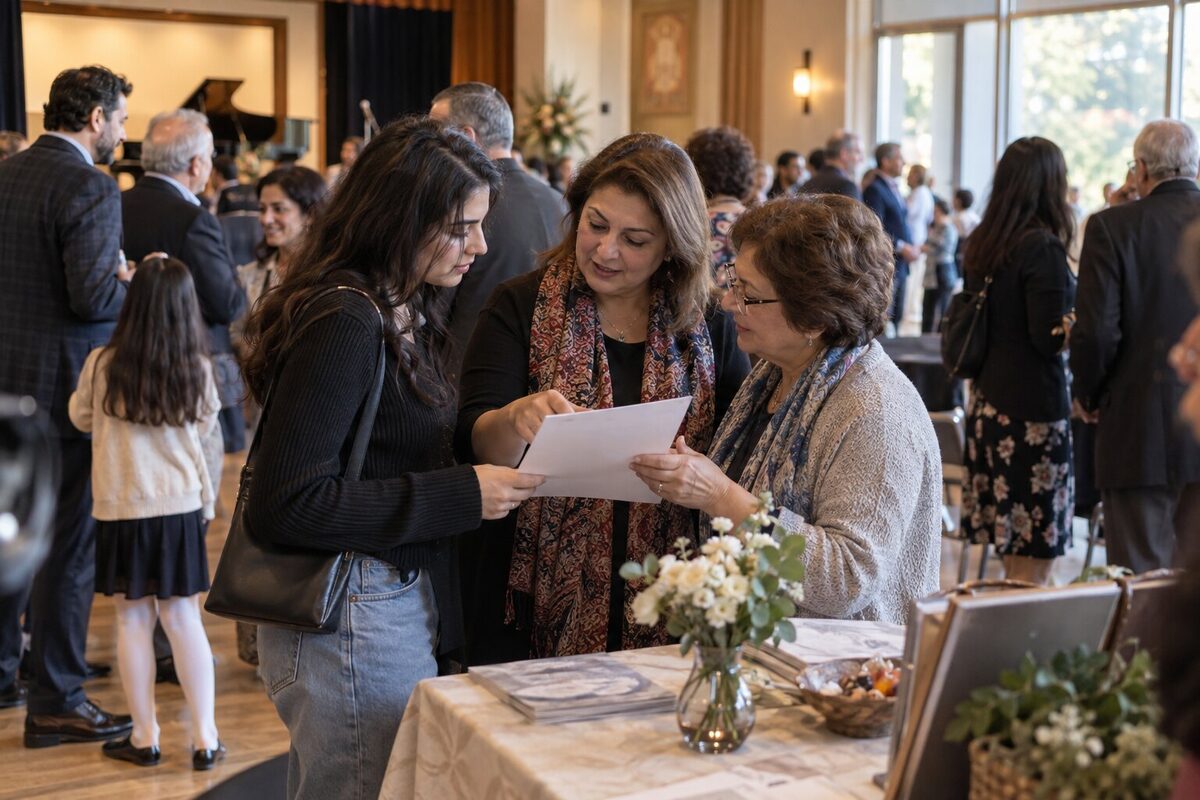
An Armenian community event can be full of familiar faces and still contain many different audiences.
Some guests speak Armenian every day. Some understand Western Armenian but answer in English. Some grew up with Eastern Armenian. Some recently arrived from Armenia. Others know a few phrases, family names and the feeling of being Armenian more strongly than the language itself.
If an event assumes everyone follows everything in exactly the same way, a portion of the room spends the evening politely pretending.
Translation is not an apology
Providing context in English does not make an Armenian event less Armenian. It makes the meaning available to more Armenians—and to friends, spouses, colleagues and neighbors who came because they care.
This matters in Los Angeles, where the community includes multiple generations, migration histories, schools, churches and social circles. The diaspora is connected, but it is not linguistically identical.
A translated welcome, short program note or well-placed explanation says, “You belong in this room even if every word is not already yours.” That is hospitality.
Do not translate every syllable
Good inclusion does not require doubling the length of the program. Word-for-word repetition can flatten the energy and test everyone’s patience.
Translate the parts people need in order to understand the moment: who is being introduced, why a person or tradition matters, what the audience is being asked to do and where the program is going next.
A skilled bilingual host can summarize naturally rather than replaying entire speeches. Printed programs can include a short English overview. Video screens can carry unobtrusive subtitles when the venue supports them. Organizers can also place fuller translations online for guests who want more depth before or after the event.
Context is sometimes more important than translation
A technically accurate sentence can still leave a newcomer confused.
If a song, poem, historical figure or organization has special meaning, explain that meaning. One clear sentence can transform a performance from something beautiful but distant into something emotionally legible.
This is especially important when younger attendees are present. They may recognize a name without knowing the story, or know the story without understanding why this particular room responds so strongly. Context gives them a way into the experience without putting them on the spot.
Pronunciation and language deserve care, not policing
There is a difference between honoring a language and using it as a test.
Hosts should prepare names and Armenian terms carefully. Organizers should give speakers pronunciation help without embarrassment. Guests should be allowed to participate without fear that one imperfect sound will become the evening’s main event.
As we have said before, you do not have to speak Armenian perfectly to belong. Events should put that belief into practice.
Make the welcome visible from the beginning
Tell people what languages the program will use. If translation or subtitles are available, mention it before tickets are purchased. If the event is primarily Armenian-language with brief English summaries, say that too.
Clear expectations respect fluent speakers and newcomers alike. Nobody arrives feeling misled, and nobody has to whisper through the first twenty minutes to figure out what is happening.
Armenian culture does not become weaker when more people can understand it. It becomes easier to carry forward. Translation is one of the ways a community opens the door without moving the house.