
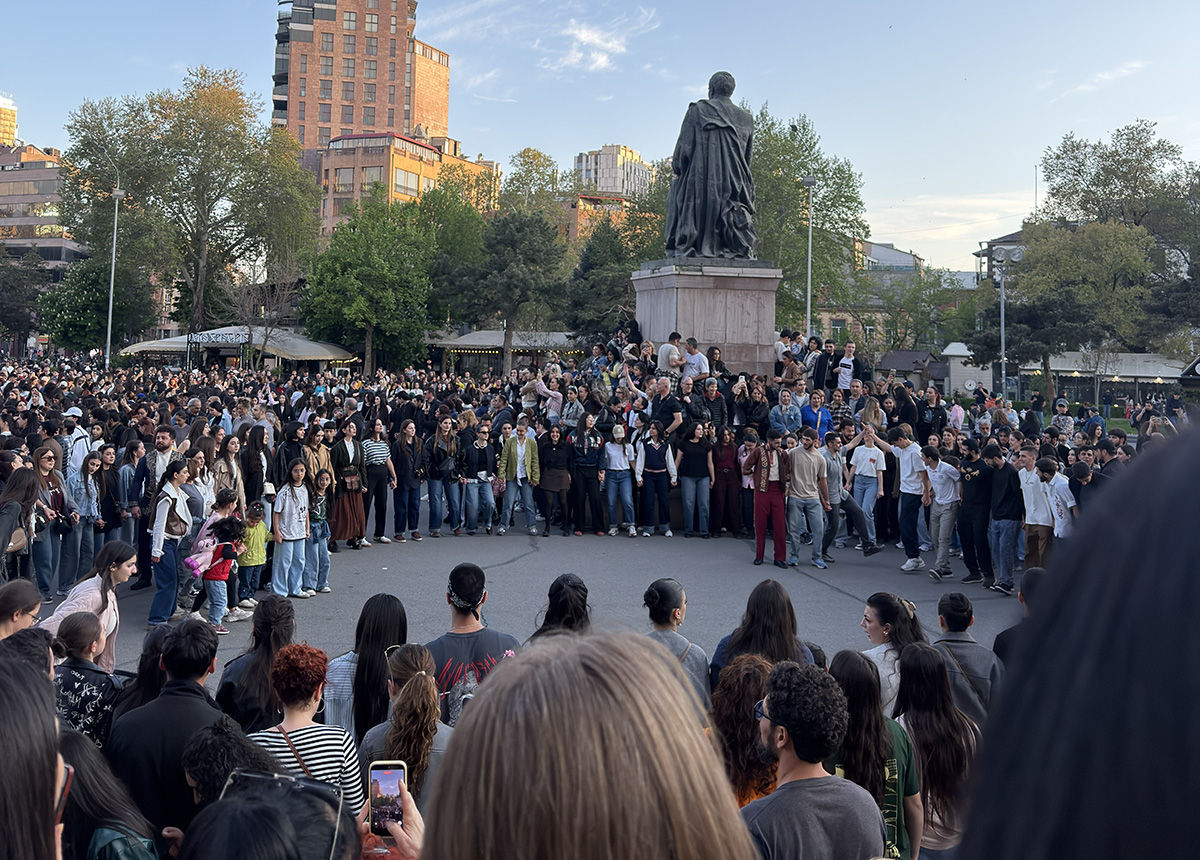
When I stepped into the Yerevan Freedom Square this International Dance Day, I was met with a sight that defied the physical limits of the space. Earlier in the evening, Republic Square had hosted the massive “Festive Circle Dance in 7 Rounds” event, but the energy had not dissipated; instead, it had surged and concentrated toward Freedom Square like a living current. It seemed as if the square itself, vast and storied as it is, could no longer contain the sheer volume of souls gathered there.
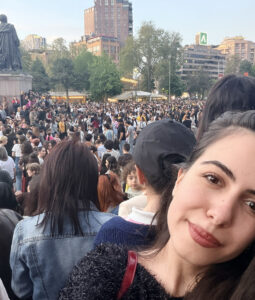
But it wasn’t the crowd that took my breath away; it was the movement.
As complete strangers linked fingers, the very ground beneath Yerevan seemed to thrum with a rhythmic, pulsing energy. It was the most beautiful earthquake I had ever witnessed; a seismic shift not of destruction, but of collective creation. It was the heartbeat of a nation, vibrated through the soles of our feet, and echoed against the surrounding stones of the Opera House. In that moment, the ground didn’t just feel like earth; it felt like a drum, and we were the beat.
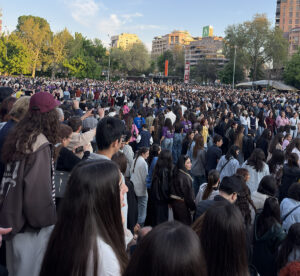
Watching the sea of dancers, I couldn’t help but feel the presence of the late Gagik Ginosyan. Though he passed in February 2024, his spirit was one of the invisible conductors of this grand symphony. For those who knew him, or even those who only knew of him, Ginosyan was more than an ethnographer; he was a spiritual cartographer who mapped the Armenian soul through movement.
Ginosyan often said, “Dance was born when, for the first time, man could not express his enthusiasm through words or even song. Dance grew, strengthened and became the crown of the arts, because it was the only one that fused the human soul and body.” Looking at the faces in the square, sweat-beaded, smiling, and fiercely determined, it was clear that no words could have better captured the gravity of this moment.
Ginosyan’s mission was never just about “steps.” It was about reclaiming a stolen identity. He saw dance as a form of “military” training for the spirit, a way to “Armenianize” the youth and strip away the complexes of the Soviet era or the pressures of globalization. To him, every stomp of the foot was a declaration of presence. Today, that presence was deafening. The legacy he left, the Karin Traditional Song and Dance Ensemble and the “We and Our Dance” initiative, has ensured that the Armenian soul continues to beat to the rhythms of our ancestors.
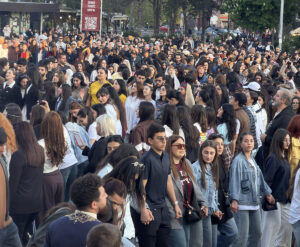
In our previous conversations, Ani Ginosyan, Gagik’s daughter and worthy successor, reflected on the heavy responsibility she now holds. “We would not be his real disciples if we did not carry these ideas within ourselves,” she told me. She has been a member of the ensemble since 2010, and worked alongside her father to plan the very performances and tours that keep our culture alive. She shared a piece of advice her father gave her that has stayed with me: “Life is a race, I’ve set a clear finish line for myself and I must reach it; I don’t have time to stop and engage in pointless fights with others.” Tonight, in the middle of Freedom Square, that finish line felt closer. Such initiatives are the reason why a teenager in 2026 feels more at home in a Kochari circle than in a modern nightclub. She is ensuring that the “dance-woven identity” her father analyzed so deeply remains a living, breathing reality for the next generation.
Among the swirling circles of the dance, I noticed a woman standing slightly apart. She wasn’t dancing yet, but her eyes were fixed on the participants as if she were trying to memorize every vibration, every turn of the hand, every stomp of the boot. I overheard her speaking English and, curious about what brought her to the heart of Yerevan on such a night, I struck up a conversation.
Her name was Amy Tchakmakjian Demetria. “It was my dream to visit Armenia,” she told me, her voice trembling with an emotion that felt both heavy and light. Amy’s eyes filled with tears. I asked her what moved her so deeply.
“My father was Armenian,” she whispered, her gaze not leaving the dancers. “But he never managed to visit. He lived his whole life dreaming of this soil, these mountains, this music. He never saw this.”
Amy stood there, phone in hand, continuously capturing photos and videos in a state of complete awe. She wasn’t just a tourist; she was a daughter fulfilling a multi-generational longing. She was the bridge between a father who could only dream of Armenia and a reality that was now vibrating under her own feet. Around us stood people of all nationalities, tourists from Europe, neighbors from the Middle East, and Armenians from the furthest corners of the Diaspora. Some were attempting the intricate steps for the first time, while others simply stood in silence, mesmerized by the power of a culture that refuses to be silenced.
There is a profound philosophy embedded in the Armenian round dance (shurjpar). It is one of the few art forms that requires the surrender of the individual to the collective. In a circle, there is no “first” and no “last.” Everyone is equal, and everyone is responsible for the rhythm of the person standing next to them.
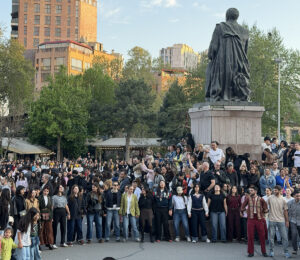
Seeing thousands of people, young and old, local and Diasporan, conservative and liberal, holding hands shows that unity among Armenians is not just a poetic dream; it is an achievable, tangible reality. For years, we have spoken of the “Armenian World” as a fragmented thing, scattered by history and divided by politics. But in Freedom Square today, those divisions evaporated.
When we hold hands in a dance, we are not just holding fingers; we are holding souls. We are bringing our minds together in a singular focus. This is the lesson Ginosyan wanted us to learn. He proved that dancing is not “shameful” or “backward”; it is encouraging, inspiring, and sobering. It is one of the ultimate tools for “Armenianizing” our future.
The message of the night was clear: Regardless of how different we are, we possess a common rhythm. We just need to bring our hands and minds together. If we can maintain the discipline and unity required to dance a perfect Kochari with thousands of people, we can maintain the unity required to protect our borders and build our nation. When we link our hands and move as one, we become a powerful force. We unite, and we will win.
As the night progressed and the moon rose over the city, the complex that traditional culture is an “old” thing felt like a distant, forgotten shadow. The energy in Freedom Square was more “modern” and more “alive” than any pop concert could ever hope to be. We weren’t just dancing to the past; we were dancing into the future.
The “Incense-Scented Land” (Khngahot Ergir) that Gagik Ginosyan dreamt of, the ancestral homeland that he explored through the dialogue between a grandfather and a grandson, was not just a memory on a stage. It was right there, in the middle of Yerevan. It lived in the sweat of the dancers, in the tears of Amy Demetria, and in the awe of the observers.
Gagik Ginosyan once quoted Komitas, saying: “Dance expresses the characteristic features of each nation, especially its morals and degree of civilization.” If the world was watching us in Freedom Square tonight, they saw a civilization that is vibrant, unbreakable, and deeply connected. They saw a people who know how to turn the ground into a drum and their history into a victory.
As I walked away from the square, the rhythm followed me through the streets of Yerevan. The earthquake was still happening, not in the ground, but in the hearts of everyone who had been there. We are a “dance-woven” people, and as long as we keep holding hands, the music will never stop.
By Milena Baghdasaryan